<?xml version="1.0" encoding="UTF-8"?>
<?xml-stylesheet type="text/xsl" href="/stylesheets/feed.atom.xml" media="screen"?>
<feed xml:lang="en-US" xmlns="http://www.w3.org/2005/Atom">
  <id>tag:bic.nd.edu,2005:/about/news</id>
  <link rel="alternate" type="text/html" href="https://bic.nd.edu"/>
  <link rel="self" type="application/atom+xml" href="https://bic.nd.edu/about/news.atom"/>
  <id>tag:bic.nd.edu,2005:/latest</id>
  <title>Biophysics Instrumentation Core Facility | News</title>
  <updated>2025-08-08T16:51:00-04:00</updated>
  <link rel="alternate" type="text/html" href="https://bic.nd.edu/"/>
  <link rel="self" type="application/atom+xml" href="https://bic.nd.edu//about/news.atom"/>
  <subtitle>The Biophysics Instrumentation Core (BIC) Facility offers sophisticated instrumentation dedicated to characterizing biomolecular conformations and interactions</subtitle>
  <entry>
    <id>tag:bic.nd.edu,2005:News/174243</id>
    <published>2025-08-08T16:51:00-04:00</published>
    <updated>2025-08-15T16:59:47-04:00</updated>
    <link rel="alternate" type="text/html" href="https://bic.nd.edu/about/news/scientists-discover-key-protein-folding-step-a-race-between-folding-and-misfolding/"/>
    <title>Scientists Discover Key Protein Folding Step: A Race Between Folding and Misfolding</title>
    <summary type="text">
      <![CDATA[A breakthrough by researchers at the University of Notre Dame has uncovered a crucial step in the life of a protein that may determine whether it works properly or instead ends up misfolded and non-functional. Their findings reveal a surprising race at the heart of protein folding, and offer new hope…]]>
    </summary>
    <content type="html">
      <![CDATA[<p>A breakthrough by researchers at the University of Notre Dame has uncovered a crucial step in the life of a protein that may determine whether it works properly or instead ends up misfolded and non-functional. Their findings reveal a surprising race at the heart of protein folding, and offer new hope for understanding diseases like Alzheimer’s, Parkinson’s, and others linked to protein malfunction.</p>
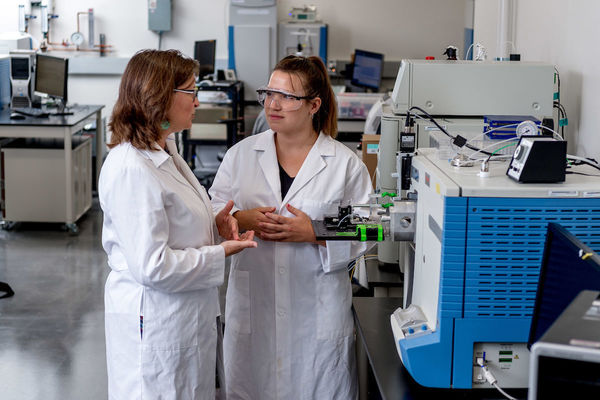
<p>The research, led by Qing Luan and <a href="https://chemistry.nd.edu/people/patricia-clark/">Patricia Clark, the Rev. John Cardinal O’Hara C.S.C. Professor of Biochemistry,</a> focuses on how a large protein called pertactin, produced by bacteria, manages to fold into its correct shape. Proteins are long linear polymers that have different folding properties depending on their chemical structure and folding environment. Pertactin is much larger than most proteins typically used by scientists as models to study protein folding, but it is similar to the average size of all proteins in our cells. In the test tube, pertactin folds so slowly that scientists have long suspected it might be getting stuck along the way, and that the environment in the cell might help it avoid getting stuck in misfolded shapes.</p>
<p>Now, thanks to a clever new approach, the Notre Dame team has discovered a short-lived, “in-between” structure — named PFS* — that lies along the pathway for folding and acts like a fork in the road. At this crucial point, pertactin can either continue toward its proper folded form or fall into a misfolded trap that it may never escape.</p>
<p><strong>The Tortoise and the Hare, Reimagined</strong></p>
<p>To explain their findings, Luan and Clark use a familiar story: Aesop’s fable The Tortoise and the Hare. In their version, the “hare” follows the correct folding path: fast and efficient. The “tortoise” takes the fork in the road that leads to the misfolded shape that is quite stable. It’s a slow process but difficult to undo.</p>
<p>“If the protein hesitates too long in this intermediate state, the tortoise wins,” said Professor Clark. “It ends up misfolded. But if it keeps moving quickly, it can get to the correct shape. The hare wins — and the protein functions as it should.”</p>
<p>This balance between speed and stability helps explain why protein folding can go wrong, and why some conditions — like those inside cells — can help proteins fold correctly while others increase the risk of failure.</p>
<p><strong>Finding What’s Been Hiding in Plain Sight</strong></p>
<p>The newly discovered folding intermediate, PFS*, is tricky to spot. It looks almost identical to the stable misfolded form of the protein (called simply PFS) when viewed using traditional methods to study protein folding. The difference? PFS* is unstable and temporary, while PFS is stable and stuck.</p>
<p>To catch this fleeting moment at the junction between folding and misfolding, Luan and Clark designed a special experiment known as a “double-jump denaturant challenge.” They briefly allowed pertactin to fold, waiting just long enough for PFS* to form, then quickly added just enough of a chemical called a denaturant to rapidly unfold PFS* but leave the stable misfolded PFS state unaffected. Then, they watched how the protein reacted. If pertactin unfolded quickly when the denaturant was added, they knew they had caught PFS* before it turned into the misfolded PFS.</p>
<p>“This gave us a time-lapse snapshot of the decision point between folding correctly and misfolding,” said Luan. “And for the first time, we could see that PFS* is a separate state that determines the fate of the folding process.”</p>
<p><strong>A Folding Process with Direction</strong></p>
<p>Another key insight from the study is that pertactin folds in a specific direction, from one end to the other: specifically, from its C-terminal end to its N-terminal end. This was a surprising discovery because it matches how pertactin folds in living bacteria, where it folds while it is “pushed” out of the cell, starting with its C-terminal end. Luan and Clark found that progressive folding from the C-terminal end helps prevent parts of the protein from getting tangled with each other, which can slow down folding and lead to misfolding.</p>
<p><strong>Why This Matters for Human Health</strong></p>
<p>Misfolded proteins are a known factor in many serious illnesses. Misfolded proteins can clump together and form harmful aggregates that damage cells. By identifying the exact moment when a protein chooses between proper folding and misfolding, this study opens the door to ultimately developing new treatments that could tip the balance in favor of healthy, properly folded proteins.</p>
<p>“If we can find ways to help proteins move through PFS* to the correctly folded structure more quickly, we might be able to prevent them from ever misfolding,” said Clark.</p>
<p><strong>A Path Forward</strong></p>
<p>The research offers not just a scientific advance, but a shift in how we think about folding: it’s not just the final shape that matters, but the journey to get there — and how fast it happens.</p>
<p>The study, “Identification of an On-Pathway Protein Folding Intermediate Illuminates the Kinetic Competition Between Folding and Misfolding”, was published in Proceedings of the National Academy of Sciences. Research in Clark’s lab is funded by the National Institutes of Health.</p>
<p> </p>
<p class="attribution">Originally published by <span class="rel-author">Samantha Keller</span> at <span class="rel-source"><a href="https://science.nd.edu/news-and-media/news/scientists-discover-key-protein-folding-step-a-race-between-folding-and-misfolding/">science.nd.edu</a></span> on <span class="rel-pubdate">August 07, 2025</span>.</p>]]>
    </content>
    <link rel="enclosure" type="image/jpeg" href="https://bic.nd.edu/assets/625111/untitled_design_19_.jpg" title="Patricia Clark, Qing Luan"/>
    <author>
      <name>Samantha Keller</name>
    </author>
  </entry>
  <entry>
    <id>tag:bic.nd.edu,2005:News/138656</id>
    <published>2021-07-06T09:00:00-04:00</published>
    <updated>2025-01-08T15:17:35-05:00</updated>
    <link rel="alternate" type="text/html" href="https://bic.nd.edu/about/news/biophysics-instrumentation-core-facility-acquires-new-surface-plasmon-resonance-instrument/"/>
    <title>Biophysics Instrumentation Core Facility acquires new surface plasmon resonance instrument</title>
    <summary type="text">
      <![CDATA[The Biophysics Instrumentation Core (BIC) Facility at the University of Notre Dame is currently installing a new research instrument with potential applications for combating diseases such as antibiotic resistant infections, allergies, cancer, strokes, and autoimmune…]]>
    </summary>
    <content type="html">
      <![CDATA[<p>The <a href="https://bic.nd.edu/">Biophysics Instrumentation Core (BIC) Facility</a> at the University of Notre Dame is currently installing a new research instrument with potential applications for combating diseases such as antibiotic resistant infections, allergies, cancer, strokes, and autoimmune and neurodegenerative disorders. The instrument will be available for use by mid-July.</p>
<p>The new <a href="https://bic.nd.edu/instrumentation/surface-plasmon-resonance/">Biacore T200 Surface Plasmon Resonance (SPR) System</a>, manufactured by Cytiva, will be used to rapidly and precisely measure interactions between proteins, nucleic acids, lipids, drugs, inhibitors, and other organic compounds, such as binding affinity, kinetics, specificity, and concentration. The expanded access to SPR measurement capabilities will accelerate Notre Dame’s research projects devoted to understanding and improving specificity in cellular immunity, characterizing the molecular functions of bacteria including interactions of pathogenic and beneficial bacteria with host cells, and designing small molecule inhibitors of molecular chaperones with anti-cancer and neuroprotective effects.</p>
<p>Funds to purchase the Biacore T200 SPR were awarded to the BIC through the competitive National Institutes of Health (NIH) S10 shared instrumentation grant program. BIC staff scientist Giselle Jacobson coordinated the overall proposal preparation, which involved contributions from 13 NIH-funded investigators from Notre Dame’s Departments of Chemistry and Biochemistry, Biological Sciences, and Civil and Environmental Engineering and Earth Sciences. <a href="https://chemistry.nd.edu/people/brian-m-baker/">Brian Baker</a>, Coleman Professor of Life Sciences and chair of the Department of Chemistry and Biochemistry served as principal investigator of the NIH proposal, reflecting his more than 20 years of expertise with SPR measurements. </p>
<p>“We are grateful to the NIH for recognizing the positive impact that this T200 SPR will have on biomedical research projects at Notre Dame,” said <a href="https://chemistry.nd.edu/people/patricia-l-clark/">Patricia Clark</a>, John Cardinal O’Hara, C.S.C. Professor of Chemistry and Biochemistry, associate vice president for research, and BIC faculty director. “Housing this instrument in the BIC will allow it to support both current, ongoing projects at Notre Dame and enable research teams new to SPR to carry out initial proof-of-concept experiments as part of their development of new research directions.”</p>
<p>The Biacore T200 SPR complements a suite of existing specialized instruments in the BIC, each capable of characterizing unique aspects of biomolecular conformations and interactions, as well as equipment for the isolation and purification of macromolecules for subsequent detailed biophysical analysis. </p>
<p>The BIC is a shared user core facility supported by the College of Science, College of Engineering, and Notre Dame Research. The BIC, which provides instrument training as well as one-on-one consultations for experiment design and data analysis, welcomes users from across the Notre Dame community and the surrounding area. Learn more at <a href="http://bic.nd.edu">bic.nd.edu</a>.</p>
<p>Contact:</p>
<p>Giselle Jacobson / Staff Scientist</p>
<p>Biophysics Instrumentation Core Facility / University of Notre Dame</p>
<p><a href="mailto:gjacobso@nd.edu?subject=Biacore%20Query">gjacobso@nd.edu</a> / 574.631.3556</p>
<p>About Notre Dame Research:</p>
<p>The University of Notre Dame is a private research and teaching university inspired by its Catholic mission. Located in South Bend, Indiana, its researchers are advancing human understanding through research, scholarship, education, and creative endeavor in order to be a repository for knowledge and a powerful means for doing good in the world. For more information, please see <a href="http://research.nd.edu">research.nd.edu</a> or <a href="https://twitter.com/UNDResearch">@UNDResearch</a>.</p>]]>
    </content>
    <link rel="enclosure" type="image/jpeg" href="https://bic.nd.edu/assets/433595/biacore_t200.homepg.jpg" title="Biacore T200"/>
    <author>
      <name>Brandi Wampler</name>
    </author>
  </entry>
  <entry>
    <id>tag:bic.nd.edu,2005:News/97635</id>
    <published>2019-03-20T12:20:00-04:00</published>
    <updated>2019-03-20T12:46:37-04:00</updated>
    <link rel="alternate" type="text/html" href="https://bic.nd.edu/about/news/university-of-notre-dame-announces-new-biophysics-instrumentation-core-facility/"/>
    <title>University of Notre Dame announces new Biophysics Instrumentation Core Facility</title>
    <summary type="text">
      <![CDATA[The Biophysics Instrumentation Core Facility is now open to researchers at the University of Notre Dame and external audiences, including those from other academic institutions and industry.]]>
    </summary>
    <content type="html">
      <![CDATA[<p class="image-right"><img alt="8" src="https://bic.nd.edu/assets/313458/8.2.16_biophysics_09_1_.jpg">Director Patricia Clark working in the lab with a student.</p>
<p> </p>
<p>The <a href="https://bic.conductor.nd.edu/">Biophysics Instrumentation Core</a> (BIC) Facility is now open to researchers at the University of Notre Dame and external audiences, including those from other academic institutions and industry. The facility provides access to instrumentation dedicated to characterizing biomolecular conformations and interactions as well as equipment for the isolation and purification of macromolecules for subsequent, detailed biophysical analysis.</p>
<p>“As director of the new BIC Facility, I encourage all interested faculty, staff, and student researchers to take advantage of our array of available equipment and training opportunities,” said <a href="https://chemistry.nd.edu/people/patricia-l-clark/">Patricia L. Clark</a>, John Cardinal O’Hara, C.S.C. Professor of Chemistry &amp; Biochemistry and Director of Notre Dame’s Biophysics Graduate Program. “My hope is that this facility will catalyze new research directions and collaborations between Notre Dame laboratories. I look forward to seeing the BIC support a wide variety of research projects at Notre Dame.” </p>
<p>Currently, there are 10 instruments available within the BIC Facility, with plans to upgrade a piece of equipment in 2019 and apply for external funding to support additional equipment. To see the full list of instrumentation, please visit <a href="https://bic.nd.edu/instrumentation/">bic.nd.edu/instrumentation</a>.</p>
<p>Those interested in using the facility will require training by BIC facility staff. Once trained, researchers will have 24-hour swipe card access to the facility and instrumentation.  </p>
<p>To learn more about the facility, please visit <a href="https://bic.conductor.nd.edu/">bic.nd.edu</a>.</p>
<p>Contact:</p>
<p>Giselle Jacobson / Staff Scientist</p>
<p>Biophysics Instrumentation Core Facility / University of Notre Dame</p>
<p><a href="mailto:gjacobso@nd.edu">gjacobso@nd.edu</a> / 574.631.4026</p>
<p><a href="https://bic.conductor.nd.edu/">bic.nd.edu</a> </p>
<p>About Notre Dame Research:</p>
<p>The University of Notre Dame is a private research and teaching university inspired by its Catholic mission. Located in <a href="https://southbendin.gov/">South Bend, Indiana</a>, its researchers are advancing human understanding through research, scholarship, education, and creative endeavor in order to be a repository for knowledge and a powerful means for doing good in the world. For more information, please see <a href="https://research.nd.edu/">research.nd.edu</a> or <a href="https://twitter.com/UNDResearch">@UNDResearch</a>.</p>]]>
    </content>
    <link rel="enclosure" type="image/jpeg" href="https://bic.nd.edu/assets/313458/8.2.16_biophysics_09_1_.jpg" title="8"/>
    <author>
      <name>Brandi Klingerman</name>
    </author>
  </entry>
</feed>